
 Golf Pass
PGA Coach's Ultimate Guide to the Downswing: Shallowing the Club & Pure Compression
Unlock the exact kinematic sequencing used by tour pros: initiate from the ground up, drop the club into the inside slot, and deliver explosive forward shaft lean through impact.

You cannot hit a golf ball with your shoulders. The downswing is a whip-cracking sequence: your lower body moves first, pulling the torso, which flings the arms, which cracks the clubhead through the ball at peak speed.
The Kinetic Sequence: Ground Reaction Force to Ball Speed
High-speed 3D motion capture reveals that all great ball strikers share an identical sequence of peak angular velocities. First, the pelvis reaches peak rotational speed and abruptly decelerates, braking to pass that energy to the torso. The torso peaks and brakes, slinging the arms. Finally, the wrists snap through impact.
"Amateurs try to hit with their hands from the top, creating immediate casting. The pro lets gravity drop the club into 'the slot' while turning the pelvis wide open, preserving lag until micro-seconds before impact."
When you initiate the downswing with your lead hip shifting and rotating, the trail shoulder is forced into external rotation. This naturally shallows the club shaft plane by 4° to 8°, making it impossible to slice over the top.
analyticsPGA Tour Downswing Impact Metrics (TrackMan & BodiTrak)
Hips cleared completely out of the way to clear room for the arms.
Delofts the clubhead, compressing ball into turf for maximum spin loft.
Lead leg pushes violently into the earth right before strike.
Tour players return the shaft on a plane 4° to 8° shallower than the backswing, creating an inside-out attack angle.
80% of pressure is transferred into the front heel before the club is even halfway down to impact.
Pure impact compression with forward shaft lean transfers nearly 100% of club speed directly into ball speed.
The 4 Downswing Checkpoints: From Transition to Impact
Analyze how elite players shallow the club, maintain explosive wrist lag, and compress the golf ball.
"Let the heavy clubhead fall behind you like skipping a stone across water."
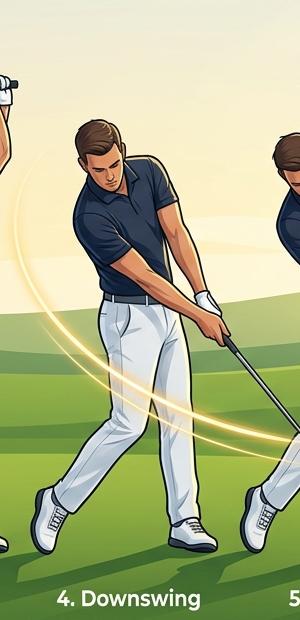
During P5, external rotation of the trail shoulder drops the club onto a shallower, inside plane. The shaft pitch flattens relative to the backswing plane, ensuring an attack path from 2° to 4° inside-to-out.
Shallowing & "The Slot" Blueprint
Over-the-Top Casting: The trail shoulder flies outward high and early, sending the clubhead outside the hands and across the ball.
The Headcover Under Right Armpit Drill: Place a driver headcover under your trail armpit and retain it until your hands reach waist height on the downswing.
The 3 Architectural Phases of the Downswing
Break down the critical move from top transition through delivery and explosive impact.
Shallowing & The Slot
P4 to P5Pressure plants firmly into the front heel while the trail elbow drops toward your shirt seam. The club shallows behind your hands, ready to strike from the inside.
The Delivery Zone
P6 (Lag Apex)Club shaft is parallel to the ground and pointing down the target line. Wrists remain hinged, ready to snap the clubhead into the ball like a catapult.

Tour Compression
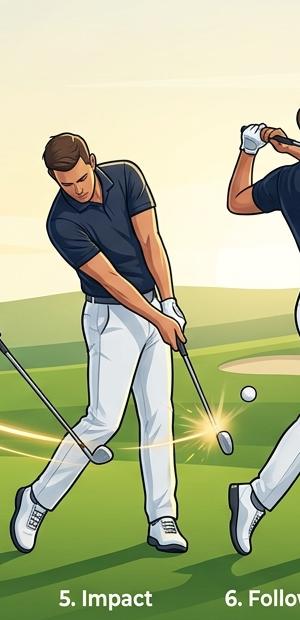
P7 (Impact)The moment of truth. Hands forward, lead wrist flat or slightly bowed, hips 40° open, with the lead leg driving straight to launch the ball on a laser flight.
The 3-Step Practice Routine to Master the Downswing

The Lead Heel Stomp
At the top of the swing, plant and stomp your lead heel into the ground before allowing your hands to drop. This locks in early ground reaction force.
Two-Pump Slot Drill
Swing down to waist height twice, feeling your right elbow tuck against your ribs and the shaft shallow. On the third downswing, release completely.
Compress Into Turf
Focus on driving the clubface through the front half of the golf ball, taking your divot 2 inches ahead of the ball. Feel your lead wrist bow firmly.
Continue to Chapter 03: Follow Through & Finish
Complete the swing cycle: learn how proper extension, chest clearance, and a balanced finish protect your spine and optimize flight.