
 Golf Pass
PGA Coach's Ultimate Guide to the Backswing: Storing Explosive Rotational Power
Master the one-piece takeaway, 90-degree shoulder coil, and correct wrist hinge to build a repetitive, tour-proven apex position that sets up effortless clubhead speed.

The backswing is not where you create speed—it is where you create the room and stored potential energy to unleash speed. A wide, coiled turn around an inclination-maintained spine eliminates 95% of downswing compensations.
The X-Factor Stretch & Rotational Plane Geometry
In elite golf biomechanics, the backswing is a helical stretch of the body's primary fascial slings. As the upper torso rotates against a stable pelvis, the abdominal obliques, latissimus dorsi, and gluteal complexes are stretched like an elastic rubber band.
"If you rush the takeaway or lift the club with your arms, you break the kinetic chain before the downswing even starts. Turn your chest, preserve your width, and let gravity and torque work for you."
When your lead shoulder turns beneath your chin without your head swaying laterally off the golf ball, your swing arc low point stays locked in place. This guarantees consistent, compression-first ball striking regardless of whether you are swinging an 8-iron or driver.
query_statsPGA Tour Top-of-Backswing Data Benchmarks (TrackMan & GEARS 3D)
Back fully points at target, chin cleared, maintaining forward spine tilt.
Resisting trail hip prevents hip slide; creates the 45° X-Factor differential.
Full 90° radial deviation lever stored with flat lead wrist facing target.
Maintaining hands as far from the right shoulder as comfortably possible maximizes angular velocity without adding muscular exertion.
Force plates reveal Tour players have 75% of body pressure loaded into the trail heel before the backswing finishes.
Cupping the lead wrist at the top forces an open clubface and is the #1 physical cause of incurable slices in golf.
The 4 Critical Backswing Positions & Coil Mechanics
Toggle through each backswing checkpoint to audit your body angles, wrist hinge, and rotational torque.
Parallel to target line & toe angled slightly forward matching spine
"Keep the chest, hands, and clubhead moving together in one solid triangle for the first 24 inches."
One-Piece Takeaway Execution
The takeaway is initiated by thoracic rotation rather than independent arm lift or wrist roll. Keeping the hands passive and the clubhead outside the hands prevents the fatal deep-inside routing that causes over-the-top hooks and slices.
Rolling the wrists immediately inside, opening the clubface to the sky and setting up an inevitable over-the-top reroute.
The Navel & Alignment Stick Drill: Place an alignment stick against your grip extending into your belly button. Rotate back 2 feet without the stick losing contact with your stomach.
The 3 Architectural Pillars of a Tour-Level Backswing
Break down your backswing into three clear physical checkpoints to ensure flawless plane alignment.
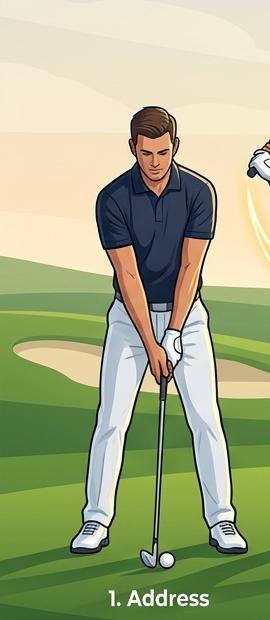
One-Piece Triangle
P1 to P2The shoulders, arms, and club move back as a single united structure. The clubhead stays outside the hands with the face matching your spine angle.
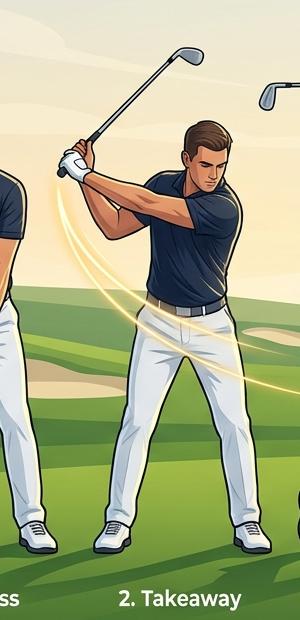
The 90° "L-Position"
P2 to P3As the lead arm reaches parallel to the ground, the wrists hinge upward into a 90° angle. The butt of the club points cleanly down at the target line.
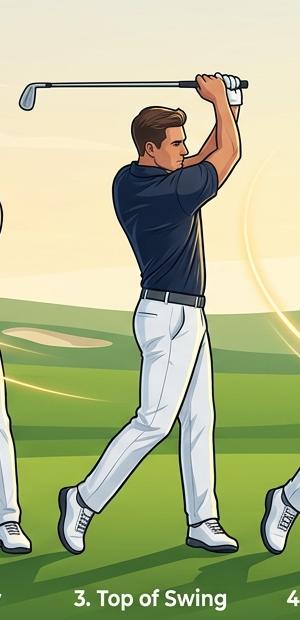
Apex Coil & Loading
P4 (Top)Full 90° shoulder turn loaded firmly into the trail hip and heel. The shaft settles parallel to the target line, primed for the downswing transition.
The 3-Step Practice Routine to Build Muscle Memory
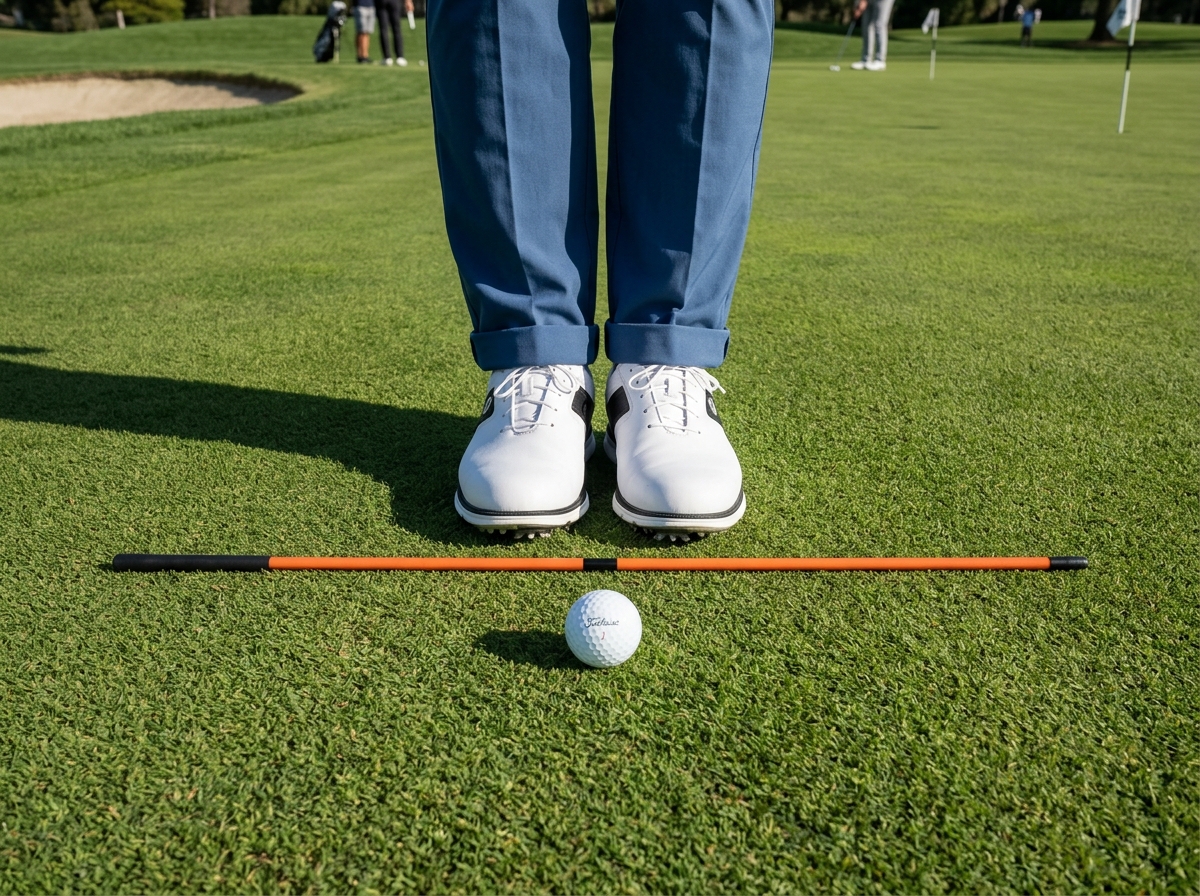
Lock In Address Triangle
Establish an athletic posture with your hands hanging naturally under your shoulders. Verify that your arms and shoulders form a solid symmetrical triangle.
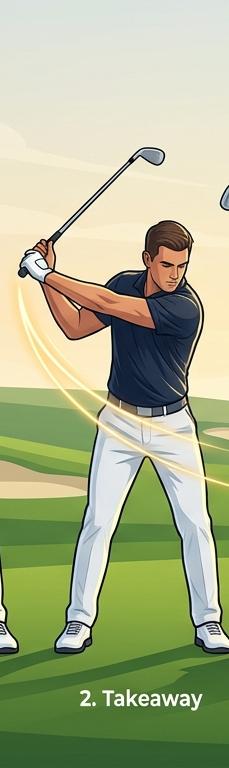
24-Inch Low Takeaway
Glide the clubhead straight back along the turf for 24 inches without twisting your wrists. The clubface should look slightly down at the ball.
Pause & Audit Apex Coil
Rotate your back to the target until your lead shoulder rests below your chin. Pause for 2 seconds to feel the deep stretch in your right glute and lat.
Continue to Chapter 02: The Downswing
Now that you have stored full rotational energy, discover how PGA Tour players initiate the transition, shallow the club, and drop into the slot.