
 Golf Pass
PGA Coach's Ultimate Guide to Pitching: The Wedge Clock Matrix
Turn dreaded in-between 40-to-80 yard wedge shots into routine tap-in birdies. Learn how to calibrate backswing length, engage club sole bounce, and produce stopping backspin.

Amateurs try to hit partial wedge shots by swinging full and decelerating. Tour pros swing at one consistent rhythm and change carry distances strictly by controlling backswing arm height.
Bounce Dynamics vs. The Leading Edge Trap
The most misunderstood aspect of pitch shots is how the bottom of the wedge interacts with the turf. Your wedges are engineered with bounce angle—the curved bulge on the bottom of the clubhead that acts like a ski gliding across snow.
"When you press your hands excessively forward, you expose the razor-sharp leading edge. If you are even a millimeter early, you chunk it. Expose the bounce and the club literally glides across the dirt."
By setting up with a neutral shaft angle (butt of club pointing at belt buckle rather than pressed forward toward target), the bounce prevents the club from digging. Even on tightly mown fairways, you get a crisp, one-hop-and-stop strike.
query_statsPGA Tour Wedge Pitching Benchmarks (TrackMan 40-70 Yds)
Clean groove grab generates check on second bounce.
PGA Tour average proximity from 50–75 yards from fairway.
Near-neutral shaft enables the sole bounce to glide smoothly.
Tight grip tension destroys wrist hinge feel. Keep forearm muscles completely relaxed for delicate touch.
Slight 60/40 lead foot bias anchors your swing low point without needing any lateral shift during backswing.
A tiny smudge of dirt or moisture cuts backspin by over 40%, causing the ball to jump forward uncontrollably.
Interactive Wedge Distance & Spin Calibrator
Dial in carry distances from 20 to 115 yards by pairing wedge loft with clock backswing positions.
Chest high. Solid torso pivot with steady hands and crisp ball-first turf clip.
Engaging the Wedge Bounce
To hit crisp pitches that stop on command, you must expose the bounce sole rather than digging the sharp leading edge into the turf.
Decelerating into the ball out of fear of sailing the green. A confident 9:00 clock swing with steady acceleration always stops close.
Hit 5 balls with each clock position on the range with an alignment stick at your target carry distance to write your personal yardage card.
The 3 Primary Clock Positions Every Golfer Needs
Calibrate three consistent arm backswing lengths to govern your scoring yardages.
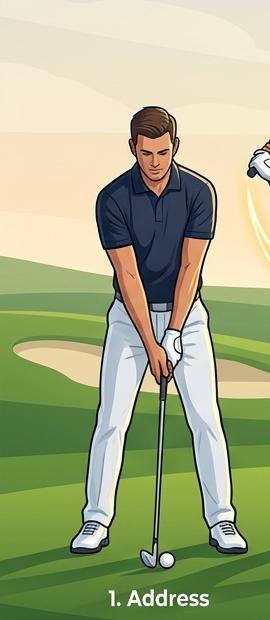
The 25–45 Yard Brush
7:30 ArmLead arm swings to hip height. Gentle wrist set, torso rotates through to mirror 4:30 finish height. Ball pops high and stops softly.
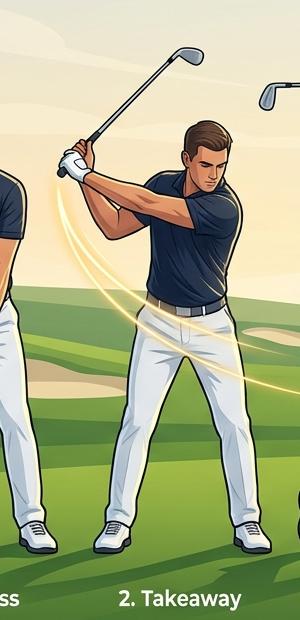
The 50–75 Yard Pin Hunter
9:00 ArmLead arm parallel to ground with full 90° wrist cock. Torso drives through to chest-facing-target finish. Maximum spin loft and check.
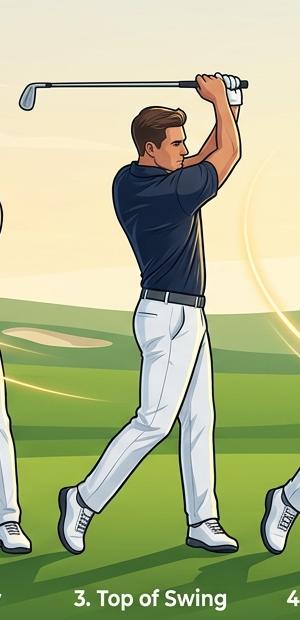
The 75–100 Yard Controlled
10:30 ArmThree-quarter swing preventing the ballooning spin surges of 100% full wedge hacks. Penetrating trajectory unaffected by wind.
Continue to Chapter 02: Chipping & The Rule of 12
Learn how to get up and down from greenside fringes using the Tour Rule of 12 carry-to-roll ratio.